





Understanding how vaginal flora works helps us distinguish between widespread myths, marketing promises, and what science actually confirms about intimate health.
Balance in our intimate areas is something you usually only think about after you start feeling that something isn’t quite as usual. The vaginal environment is very sensitive to a range of influences, from hormonal changes and stress to antibiotics, hygiene, and sexual acts. That’s why the vaginal microbiota is a dynamic, living system. When you understand how it works, it’s easier to tell the difference between common myths, marketing promises, and what science actually confirms about our intimate health.
What is the vaginal microbiota and why is there so much talk about lactobacilli?
In recent years, the vaginal microbiota has often been mentioned in scientific literature and in the media. It’s a community of microorganisms that naturally inhabit the vagina and play an important role in keeping its ecosystem balanced. In many women, the predominate bacteria in this area is of the genus Lactobacillus, which is why you hear about these species the most.
Among the most commonly described species in scientific reviews are:
Lactobacillus rhamnosus
L. crispatus
L. iners
L. gasseri and
L. jensenii
That said, it’s important to note that the composition of the vaginal microbiota is highly individual. It varies from one woman to another and can also change over your lifetime – for example during periods of hormonal change, in pregnancy, after taking antibiotics, or in various phases of your menstrual cycle.
Vaginal pH
One of the reasons why lactobacilli are so often in the spotlight is their link with a more acidic vaginal environment. These bacteria contribute to the production of lactic acid, which helps maintain a lower vaginal pH. The scientific literature describes such an environment as a factor limiting the overgrowth of certain other, potentially harmful microorganisms.
It’s also important to understand that vaginal balance isn’t a static state, but a dynamic system that can change over time. Occasional changes in how you feel or in your discharge aren’t necessarily a reason to worry, since the microbiota is influenced by many everyday factors – from stress and hormonal fluctuations to hygiene, sex, or medications.
But if you notice pronounced symptoms, such as a strong fishy odor, burning, itching, pain, unusual discharge, or issues during pregnancy, the safest step is to talk to a healthcare professional. Conditions like bacterial vaginosis (BV) or other infections have clearly defined clinical guidelines for diagnosis and treatment, so professional care is always the most reliable choice.
Not all probiotics are the same: strain and quantity matter
The term probiotic has a quite specific meaning in scientific literature. By definition, it refers to live microorganisms that can contribute to certain health benefits when consumed in adequate amounts. However, it’s important to emphasize that these benefits are typically proven at the level of specific bacterial strains, not just at the species level. [1]
This is why there's a big difference between the general name of a bacterium and its specific strain. For example:
Lactobacillus rhamnosus indicates the species of the bacterium,
while labels like GR-1, GG, or CRL1505 refer to specific strains that have been the subject of specific research.
In scientific studies, it often shows that properties and effects can vary even among the same species of bacteria, which is why it is crucial for probiotics that the strain is clearly defined. [2]
Why the quantity of live cultures matters
Beyond the strain itself, the quantity of live microorganisms is also important. Probiotics are living organisms, so their number can gradually decrease during storage. For this reason, expert guidelines recommend that producers state the minimum number of live bacteria at the end of the shelf life, not just at the time of production. [3]
This information provides a more realistic picture of how many live cultures the product actually contains at the time of use.
What CFU means and why mg isn’t always enough for probiotics
For probiotics, the quantity is often expressed in terms of CFU (colony-forming units). This is an operational measure that estimates the number of live microorganisms capable of forming colonies under laboratory conditions. That’s why CFU is used in practice as a more relevant unit to describe the quantity of live bacteria, as weight in milligrams (mg) alone doesn’t tell how many microorganisms are actually alive. [4]
In the product specification for Junai HER, it is clearly stated that one capsule contains 10 mg of Lactobacillus rhamnosus (strain CRL1505), which corresponds to 1 × 10⁹ live bacterial cells (CFU). The recommended daily dose is two capsules a day, which means a total of about 2 billion live cultures of Lactobacillus rhamnosus daily.
This quantity fits well within the ranges typically used for probiotics in dietary supplements, where daily doses usually range between 10⁸ and 10¹⁰ CFU, depending on the strain and purpose of use.
It’s also important that with probiotics, it is clearly defined:
which strain of the bacterium is used (in this case Lactobacillus rhamnosus CRL1505),
how many live cultures the product contains, expressed in CFU.
Junai HER transparently provides both the strain of the bacteria and the quantity, allowing for a more professional interpretation of the composition and easier comparison with other probiotic products on the market.
In fact, for many probiotics on the market, only the general name of the bacterium or the mass in milligrams is often stated, while data about the specific strain or the number of live cultures is not always clearly defined. That’s why information about the strain, quantity of CFU, and dosage is crucial for understanding the quality of the probiotic supplement.
How Lactobacilli Help Maintain a Low Vaginal pH
One of the key features of a healthy vaginal microbiome is a slightly acidic environment, which for most women ranges approximately between pH 3.8 and 4.5. [5] This environment is associated with a greater presence of bacteria from the Lactobacillus genus, which play an important role in maintaining microbiological balance.
Lactobacilli metabolize glycogen, which is found in the vaginal epithelium, producing lactic acid in the process. It’s lactic acid that is one of the main factors contributing to a lower vaginal pH. [6] In the scientific literature, this acidic environment is described as one of the natural mechanisms that can help limit the overgrowth of certain other microorganisms.
In addition to lactic acid, some lactobacilli can also produce other substances, such as bacteriocins or hydrogen peroxide, which are also associated with maintaining balance in the vaginal ecosystem. [7] Because of these properties, bacteria from the Lactobacillus genus are often described as an important part of the natural protective flora.
However, it’s important to understand that the vaginal microbiota is not static. Its composition can be influenced by many factors, such as:
hormonal changes
menstrual cycle
stress
antibiotics
sexual activity
changes in hygiene or lifestyle
Therefore, the balance of the microbiota can change throughout your life, which is part of normal biological dynamics. Research in the field of vaginal microbiology often emphasizes that understanding the role of lactobacilli is mainly a matter of the balance of the entire microbiological system, not just the presence of a single bacterial species.
Junai HER and classic probiotic supplements: what's the difference?
Many probiotic dietary supplements on the market are designed quite simply: they contain one or more bacterial cultures primarily aimed at supporting the gut or vaginal microbiota. These products typically focus on a single mechanism of action: adding live bacteria.
Junai HER takes a slightly broader approach. The formula includes a probiotic strain Lactobacillus rhamnosus CRL1505, which is present in the product in a quantity of about 1 × 10⁹ live bacterial cells (CFU) per capsule, meaning about 2 billion live cultures in the recommended daily dose. This amount fits well within the ranges commonly used in probiotic supplements on the market, where daily doses usually range from 10⁸ to 10¹⁰ CFU, depending on the strain and intended use.
In this sense, Junai HER contains a comparable amount of probiotic as many specialized probiotic products. The difference, however, is that the probiotic in the formula is not used as the only ingredient, but as the foundation of a broader, multi-system formula.
Support for multiple systems in a woman's body
Junai HER is designed to address not only the vaginal microbiota but also other aspects of women's well-being, which are often interconnected.
The formula therefore includes, in addition to the probiotic, ingredients such as:
vitamin B6, which contributes to regulating hormonal activity and reducing fatigue
iodine from the seaweed Fucus vesiculosus, which contributes to normal thyroid function
lemon balm (Melissa officinalis), traditionally used to support relaxation and well-being
rosemary (Rosmarinus officinalis), a plant extract with antioxidant properties
chlorella (Chlorella vulgaris) as a source of plant nutrients
and piperine from black pepper, often added for better absorption of certain bioactive compounds
This combination means that the probiotic in the formula is not replaced or diminished but serves as a core element on which other ingredients build.
Traditional probiotic or multi-component formula?
To simplify the comparison:
Classic Probiotics | Junai HER |
❌ multiple separate products | 💚 one formula |
❌ focus on one problem | 💚 support for 3 systems |
❌ often without probiotics | 💚 contains Lactobacillus |
❌ no hormonal support | 💚 contains iodine + plant extracts |
❌ multiple capsules per day | 💚 easy to use |
This approach is becoming more common in modern dietary supplements as many formulas attempt to combine microbiological support, micronutrients, and plant ingredients in one product.
It's important to emphasize that dietary supplements are not meant for treating diseases. Their role is primarily to support normal physiological functions of the body, and it is always advisable to consult a healthcare professional in case of health issues.
Understanding balance means better decisions
When we talk about the vaginal microbiota, probiotics, and women's well-being, the most important thing to understand is that the body operates as a connected system. Vaginal flora, hormonal balance, stress, energy, and overall well-being are not separate processes; they often intertwine and affect each other.
Scientific literature in recent years increasingly emphasizes the role of bacteria from the Lactobacillus genus in maintaining a healthy vaginal environment, primarily due to their link with lower vaginal pH and a more stable microbiological balance. At the same time, studies clearly show that, with probiotics, it’s always essential to understand the specific strain, the amount of live cultures, and the area in which the strain was studied.
This is exactly why the development of dietary supplements is gradually shifting from very narrow formulas towards more holistic approaches, which consider other factors of women's well-being in addition to the microbiota. Such formulas combine probiotics, micronutrients, and plant ingredients that can support multiple physiological systems simultaneously.
Junai HER follows just such an approach. Its formula combines the probiotic strain Lactobacillus rhamnosus CRL1505 in an amount comparable to many probiotic products, while also supplementing it with selected plant extracts and micronutrients that support various aspects of women's balance.
For readers, the most important message is simple:
when choosing a dietary supplement, it makes sense to look at the big picture, including which strain of bacteria the product contains, how many live cultures are present, what other ingredients complement the formula, and what approach to women's balance the product actually represents.
Understanding these basics helps distinguish between marketing, myths, and actual scientific data, allowing each woman to choose the support that best fits her body and lifestyle.
FAQ – Frequently Asked Questions about Vaginal Microbiota, Lactobacilli, and Probiotics
1. What is vaginal microbiota?
Vaginal microbiota is a community of microorganisms that naturally live in the vagina. In many women, bacteria of the genus Lactobacillus dominate, helping to maintain an acidic environment and a stable microbial balance. The composition of the microbiota can change throughout life due to hormones, stress, antibiotics, or other factors.
2. Is vaginal flora the same as vaginal microbiota?
In everyday language, the terms are often used interchangeably. However, in scientific literature, the term microbiota is more precise as it describes the entire community of microorganisms (bacteria, fungi, and other microbes) that inhabit a specific environment in the body.
3. Why are lactobacilli important for vaginal balance?
Bacteria of the genus Lactobacillus are associated with the production of lactic acid, which helps maintain a lower vaginal pH. This acidic environment is described in literature as one of the natural mechanisms that can limit the overgrowth of certain other microorganisms.
4. What does CFU mean in probiotics?
CFU (colony forming units) is a unit that indicates the number of live microorganisms in a probiotic product. Since probiotics are live organisms, it's important for manufacturers to specify the minimum amount of CFU by the expiration date, not just at production time.
5. Is every Lactobacillus rhamnosus the same?
No. In probiotics, the effects are often specific to individual strains of bacteria. This means that scientific results for one strain (e.g., GR-1 or CRL1505) do not necessarily apply to all other strains of the same species.
6. Can oral probiotics affect vaginal microbiota?
Research shows that oral probiotics can influence the microbial balance of the body, but oral intake doesn't necessarily lead to direct colonization of the vagina. The effects can be indirect and depend on the strain, dosage, and individual.
7. What can affect the balance of vaginal microbiota?
Many factors can influence vaginal microbiota, such as:
hormonal changes,
antibiotics,
stress,
menstrual cycle,
sexual activity,
changes in hygiene or lifestyle.
8. How many probiotics (CFU) are typically in dietary supplements?
In probiotic dietary supplements, daily doses often range from about 10⁸ to 10¹⁰ CFU, depending on the strain and purpose of the product. It's also important that the strain is clearly defined and that the amount of live bacteria is guaranteed until the expiration date.
9. Can dietary supplements help with vaginal balance?
Dietary supplements can contribute to supporting normal physiological functions of the body, including microbial balance. However, it's important to understand that supplements are not intended to treat diseases and do not replace medical diagnosis or therapy.
10. When is it advisable to consult a doctor?
If you experience persistent or severe symptoms, such as strong odor, burning sensation, itching, pain, or unusual discharge, it's recommended to seek medical advice. This is especially true during pregnancy or if symptoms recur.

Lactobacillus rhamnosus
A helpful bacterium that is naturally present in the human digestive tract and in the female urogenital system.
Related products
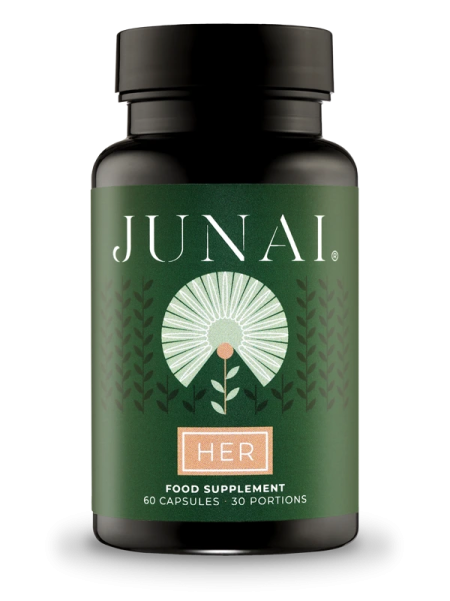
Junai Her
- Iodine from brown algae supports the thyroid.
- 10⁹ cultures of L. rhamnosus that support a healthy natural flora.
- Chlorella, vitamin B6 and black pepper help support the body’s defense against free radicals.
- Vitamin B6 contributes to the regulation of hormonal activity and helps reduce tiredness and fatigue.
Related posts

Seeing is believing: visualization as a meditative technique
Seeing is believing: boost your focus and reach the stars through the power of visualization.

The Power of Breathing
Your breath can boost your health, calm your stress, and fuel your energy.

Visualization: Seeing is Believing
How to sharpen your focus and achieve more with visualization
