




Inhalt
Kurz gesagt
KURZE ZUSAMMENFASSUNG ÜBER BLASENTANG
- Blasentang (Fucus vesiculosus L.) ist eine braune Makroalge aus dem Nordatlantik und der Ostsee, eine der kommerziell am weitesten verbreiteten und pharmakologisch am besten untersuchten Meerespflanzen in der gemäßigten nördlichen Klimazone
- Sein phytochemisches Profil umfasst organisch gebundenes Jod, Fucoidan (sulfatiertes Polysaccharid, typisch nur für Braunalgen), Phlorotannine (meeresspezifische Polyphenole), Fucoxanthin (xanthophylles Carotinoid), Algininsäure (lösliche präbiotische Faser) und ein breites Mineralspektrum, einschließlich Calcium, Magnesium, Kalium, Zink und Selen
- Das Jod aus Blasentang ist ein Rohstoff für die Synthese von Schilddrüsenhormonen (T3 und T4), die die Stoffwechselrate, Körpertemperatur, Energieproduktion und kognitive Funktion regulieren
- Fucoidan hemmt die NF-κB-Signalgebung und die durch Selektine vermittelte Anheftung von Immunzellen und reduziert in präklinischen Modellen die Bildung proinflammatorischer Zytokine; Phlorotannine hemmen zusätzlich COX-2 und iNOS; die klinischen Belege beim Menschen entwickeln sich noch
- Algininsäure bildet im Verdauungstrakt ein viskoses Gel, das die Magenentleerung verlangsamt, eine schützende Barriere gegen Säurereflux bieten kann und als präbiotische Faser die Vielfalt des Darmmikrobioms unterstützt; Fucoidan fördert in frühen Studien separat das Wachstum von Lactobacillus- und Bifidobacterium-Arten
- Fucoxanthin und Phlorotannine sind zwei der stärksten antioxidativen Klassen unter pflanzlichen Inhaltsstoffen, mit besonderer Wirkung gegen reaktive Sauerstoffspezies und Stickstoffmonoxidradikale
- Frühe Studien deuten darauf hin, dass Fucoidan möglicherweise die Aktivität der Kollagenase hemmt und den Erhalt von Hautkollagen unterstützt, obwohl die klinischen Belege hierfür noch vorläufig sind
- Blasentang hat klare und spezifische Kontraindikationen: Sprich mit einem Arzt, wenn du bereits hyperthyreote Zustände hast, Blutverdünner und Antiarrhythmika einnimmst oder Schilddrüsenmedikamente nimmst
- Standardisierte Extrakte liefern vorhersehbare Joddosen und ein deutlich geringeres Risiko einer Belastung mit Schwermetallen im Vergleich zu unkontrolliertem Ganzpflanzenpulver
- Blasentang ist das jodgebende Kernstück des Produkts Junai HER, wo er zusammen mit Melisse, Chlorella, Rosmarin, Vitamin B6, schwarzem Pfeffer und L. rhamnosus das hormonelle Gleichgewicht, die Stoffwechselregulation, Energie und Darmgesundheit unterstützt
Produkte mit dieser Zutat
Blasentang ist in diesen Junai Produkten enthalten.
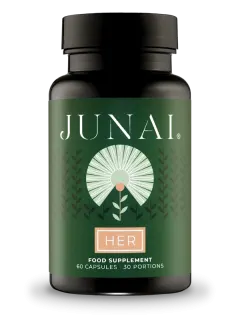
Blasentang (Fucus vesiculosus, englisch Bladderwrack) ist eine braune Meeresalge, die für ihre zahlreichen gesundheitlichen Vorteile bekannt ist. Sie kann dazu beitragen, den Spiegel weiblicher Hormone zu senken.
Weibliche Hormone
Dank ihres hohen Jodgehalts, der sich positiv auf die Schilddrüsenfunktion auswirkt, kann diese Alge zur Regulierung des weiblichen Hormonspiegels beitragen. Dies ist wichtig für das optimale Funktionieren vieler physiologischer Prozesse.
Hilft beim Stoffwechsel
Braune Meeresalgen können beim Abnehmen helfen. Durch die Anregung des Stoffwechsels und die Bereitstellung wichtiger Nährstoffe können sie Diäten unterstützen und die Gewichtskontrolle erleichtern.
Unterstützt die Gesundheit des Verdauungssystems
Mit ihren natürlichen Eigenschaften fördert diese Alge die normale Funktion des Darms und des Verdauungstrakts, was zu einer besseren Verdauung und einem allgemeinen Wohlbefinden beiträgt. Eine gesunde Verdauung ist entscheidend für die optimale Aufnahme von Nährstoffen und die Erhaltung des allgemeinen Wohlbefindens – braune Meeresalgen sind daher eine wertvolle Ergänzung der Ernährung, um dieses Gleichgewicht zu unterstützen.
WAS BLASENTANG TUT
Unterstützung für Schilddrüse und Hormone
Die Schilddrüse ist eine kleine Drüse im Hals mit einem unverhältnismäßig großen Einfluss darauf, wie du dich von Tag zu Tag fühlst. Sie reguliert deine Stoffwechselrate, Körpertemperatur, Energieniveaus und Stimmung, und bei Frauen ist ihre Funktion eng mit den Fortpflanzungshormonen verknüpft, sodass eine schlecht arbeitende Schilddrüse sich auf viele Arten äußern kann: Müdigkeit, Gehirnnebel, ein Gewicht, das sich nicht bewegt, und Zyklen, die sich nicht einpendeln. Blasentang liefert Jod in organisch gebundener Form, die die Schilddrüse leicht aufnehmen kann, und gibt ihr so das Rohmaterial, das sie für die Herstellung der Hormone braucht, die deine Systeme antreiben.
Antioxidative Wirkung
Jede Zelle im Körper erzeugt Stoffwechselnebenprodukte, von denen einige reaktive Verbindungen sind, die das umliegende Gewebe schädigen, wenn man sie unkontrolliert lässt. Blasentang enthält Florotannine und Fucoxanthin, zwei Klassen von Antioxidantien, die fast ausschließlich in Meeresalgen zu finden sind und diese reaktiven Verbindungen entfernen, bevor sie sich ansammeln können. Das ist keine Randaktivität. Es ist eine ständige, systemische Wartungsarbeit, die der Körper permanent leistet, und Blasentang gibt ihm zusätzliche Werkzeuge dafür.
Regulierung von Entzündungsprozessen
Chronische Niedriggradentzündung steht hinter einer breiten Palette von Beschwerden, die im modernen Leben fast zur Regel geworden sind: anhaltende Müdigkeit, Beschwerden in Gelenken, unregelmäßige Verdauung, Hautschübe. Der Gehalt an Fucoidan im Blasentang und in geringerem Maße seine Florotannine beeinflussen Signalwege, die die Entzündungsantwort regulieren. Die weiter unten besprochenen Forschungen reifen noch, aber die Mechanismen sind spezifisch und die vorläufigen Hinweise sind vielversprechend.
Verdauungs- und Darmunterstützung
Alginsäure, ein strukturelles Polymer, das einen großen Teil der Trockenmasse von Blasentang ausmacht, verhält sich im Verdauungstrakt wie lösliche Ballaststoffe. Sie nimmt Wasser auf, bildet eine gelartige Konsistenz und hat mehrere nachgelagerte Effekte: sie verlangsamt die Magenentleerung, kann eine schützende Schicht auf der Magenoberfläche bilden (weshalb sie in frei verkäuflichen Präparaten gegen Sodbrennen vorkommt) und nährt nützliche Darmbakterien. Fucoidan hat in frühen Studien außerdem ein präbiotisches Wirkspektrum gezeigt und unterstützt das Wachstum von Lactobacillus- und Bifidobacterium-Arten.
Hautgesundheit (vorläufig)
Einige Studien deuten darauf hin, dass Fucoidan die Kollagenbildung in der Haut unterstützen könnte. Auch die lokale Anwendung von extrakten, die reich an Florotanninen sind, zeigte in kleinen Studien entzündungshemmende Effekte auf der Haut. Die klinischen Belege hierfür sind, obwohl interessant, vorläufig.
WIE BLASENTANG WIRKT
Blasentang ist eine phytochemisch reiche Pflanze, deren gesundheitliche Vorteile beim Menschen über mehrere Pfade wirken.
Wie Blasentang die Schilddrüse und das hormonelle Gleichgewicht unterstützt
Das Jod im Blasentang liegt überwiegend in organisch gebundener Form vor, das heißt, es ist chemisch an die Kohlenstoffketten gebunden, aus denen das Algengewebe selbst besteht, und existiert nicht als freies mineralisches Jodid. Dadurch ist es deutlich biologisch nutzbarer als Jod, das nur aus anorganischen Mineralsalzen stammt.
Wenn Jod absorbiert wird, wird es aktiv gegen einen Konzentrationsgradienten in die Schilddrüse transportiert – die Schilddrüse konzentriert Jod auf Niveaus, die vielfach höher sind als im Blut – über ein spezielles Aufnahmeprotein in den follikulären Zellen der Schilddrüse, den Natrium-Jodid-Symporter. Innerhalb der Schilddrüse nimmt das Enzym Schilddrüsenperoxidase dieses Jod und bindet es an Tyrosin, eine der Aminosäuren im Proteingerüst, das die Schilddrüse zur Synthese ihrer Hormone verwendet. Dabei entstehen zwei Zwischenverbindungen, die sich dann zu Trijodthyronin (T3) und Thyroxin (T4) verbinden, den Hauptschilddrüsenhormonen, die deine Stoffwechselrate, Körpertemperatur und Energieproduktion regulieren.
T3 ist die aktive Form, T4 wird in peripheren Geweben in T3 umgewandelt. Bei Jodmangel reagiert die Hypothalamus-Hypophysen-Schilddrüsen-Achse mit einem Anstieg von TSH (thyreoidea‑stimulierendes Hormon), um die Schilddrüse stärker anzutreiben — das ist der Mechanismus hinter einer Vergrößerung der Schilddrüse bei Jodmangel. Eine ausreichende Jodzufuhr beseitigt diesen Druck.
Bei Frauen beeinflussen Schilddrüsenhormonspiegel wesentlich Östrogen und Progesteron. Östrogen erhöht die Werte des Thyroxin-bindenden Globulins (TBG), eines Proteins, das T4 im Blut transportiert, was die Verfügbarkeit freien Hormons in verschiedenen Phasen des Zyklus, während der Schwangerschaft und in der Nähe der Menopause beeinflussen kann. Das ist einer der mechanistischen Gründe, warum Schilddrüsenerkrankungen bei Frauen häufiger sind als bei Männern.
Blasentang enthält außerdem Selen, ein essentielles Spurenelement, das Cofaktor für Deiodinase-Enzyme ist, die T4 in die aktive Form T3 umwandeln. Die Konzentration im Blasentang ist moderat, aber es lohnt sich, sie als Teil des Gesamtprofils der Pflanze zu erwähnen.
Wie Blasentang oxidativen Stress reduziert
Fucoxanthin ist ein xanthophylles Carotinoid, das Singulettsauerstoff löscht und reaktive Sauerstoffspezies (ROS) sowohl durch direkte Neutralisation als auch durch Verstärkung zellulärer innerer antioxidativer Systeme entfernt, einschließlich des Nrf2-Wegs, der die Expression einer Reihe schützender Enzyme reguliert. Da Fucoxanthin fettlöslich ist, verbessert sich seine Aufnahme deutlich, wenn es zusammen mit Nahrungsfett eingenommen wird.
Florotannine sind eine Klasse von Polyphenolen, die ausschließlich von Braunalgen synthetisiert werden. Strukturell sind sie Polymere des Floroglucinols und unterscheiden sich von Polyphenolen terrestrischer Pflanzen in einer Weise, die ihnen eine besonders starke Fähigkeit zur Radikalfängerwirkung verleiht, insbesondere gegenüber Stickstoffmonoxid‑Radikalen (NO•). Untersuchungen der Florotannine aus F. vesiculosus zeigten eine besonders starke Radikalfängeraktivität gegen Stickstoffmonoxid mit DPPH-Entfernungskapazitäten, die in einigen Tests mit Ascorbinsäure vergleichbar waren.
Wie Blasentang Entzündungsprozesse reguliert
Fucoidan, ein sulfatiertes Polysaccharid in den Zellwänden von Braunalgen, hat entzündungshemmende Wirkungen über mehrere sich annähernde Mechanismen gezeigt. Seine Sulfatgruppen beeinflussen Selektine, zelluläre Adhäsionsmoleküle, die Immunzellen an Entzündungsorte rekrutieren, und verringern die Effizienz ihres Anhaftens. Fucoidan hemmt zudem den NF-κB-Signalweg, einen der Haupttranskriptionsschalter, die die Expression proinflammatorischer Zytokine einschließlich TNF-α, IL-1β und IL-6 regulieren. Die Hemmung auf NF-κB-Ebene ist ein breit wirkender Mechanismus höher in der Kette, der gleichzeitig mehrere nachgelagerte Entzündungsprozesse beeinflusst.
Es ist erwähnenswert, dass die Hemmung von NF-κB innerhalb der Formulierung Junai HER nicht nur dem Blasentang zuzuschreiben ist. Auch Rosmarin und Zitronenmelisse, die beide in der Formel enthalten sind, regulieren denselben Weg über Rosmarinsäure, ein Polyphenol, das beide enthalten. Die Verbindungen sind strukturell verschieden und erreichen dasselbe Ziel aus unterschiedlichen Blickwinkeln, was genau das ist, was eine solche Überlappung nützlich macht, ohne überflüssig zu sein. An anderer Stelle im Vorrat bei Junai zielen auch Kurkuma und Ashwagandha auf denselben Weg, wobei die kurkuminreiche Schlüsselverbindung Kurkumin der stärkste und am besten untersuchte pflanzliche NF-κB-Inhibitor ist, den wir kennen.
Separat hemmen Florotannine Cyclooxygenase‑2 (COX‑2) und die induzierbare Stickstoffmonoxid-Synthase (iNOS), zwei Enzyme, die die entzündliche Reaktion weiter unten in der Kette verstärken. Das bedeutet, dass die entzündungshemmende Wirkung des Blasentangs aus mehreren molekularen Klassen stammt, die an verschiedenen Punkten desselben allgemeinen Prozesses ansetzen. Dennoch wurden die meisten dieser Studien in vitro oder an Tiermodellen durchgeführt. Klinische Daten zu entzündungshemmenden Effekten von Blasentang beim Menschen sind rar.
Wie Blasentang Darm und Verdauung unterstützt
Alginsäure ist eine polymere Kette aus Resten der Mannuronsäure und Guluronsäure. In Gegenwart von Magensaft bildet sie ein viskoses Gel, das die Bewegung von Nahrung durch den Magen verlangsamt und so die Aufnahmegeschwindigkeit von Glukose und Fetten mäßigt (vergleiche diese mechanische Verlangsamung der Magenentleerung mit der chemischen Lösung desselben Problems bei der weißen Maulbeere). Am Übergang zwischen Speiseröhre und Magen kann Alginsäure eine physische Barriere bilden, die den Rückfluss von Säure in die Speiseröhre begrenzt, weshalb sie in pharmazeutischen Antazida verwendet wird.
Als präbiotische Faser erreicht Alginsäure größtenteils unverdaut den Dickdarm, wo sie von dort ansässigen Bakterien fermentiert wird und so die mikrobielle Vielfalt unterstützt. Fucoidan hat separat die Fähigkeit gezeigt, in frühen Studien selektiv das Wachstum von Lactobacillus- und Bifidobacterium-Arten zu fördern. Sowohl L. rhamnosus als auch andere Lactobacillus-Arten profitieren von genau dieser Art präbiotischer Unterstützung.
Wie Blasentang der Haut hilft
In noch vorläufigen Untersuchungen wurde in Laborstudien gezeigt, dass Fucoidan die Kollagenase hemmt, ein Enzym, das Kollagen im Hautgewebe abbaut. Der vorgeschlagene Mechanismus umfasst eine kompetitive Hemmung des aktiven Zentrums des Enzyms. Separat zeigten lokal aufgetragene Extrakte, die reich an Florotanninen sind, in kleinen kontrollierten Studien eine Verringerung UV‑induziierter Rötung, was man ihrem antioxidativen Wirken im Hautgewebe zuschreibt. Beide Befunde sind vorläufig, und die klinische Evidenzbasis beim Menschen ist dünn.
Forschung zum Blasentang
Als ökologisch weitverbreitetste und kommerziell am häufigsten genutzte Makroalge verfügt der Blasentang über eine reiche Forschungsgeschichte, die bis in die napoleonischen Kriege zurückreicht. Er wurde für Anwendungen von der kulinarischen Zutat bis hin zur antioxidativen Kraftquelle untersucht, vom Kollagenförderer bis zum Präbiotikum.
Stellungen der EFSA
Die EFSA hat keine gesundheitsbezogenen Angaben für Blasentang als Pflanze sowie für Fucoidan, Phlorotannine oder Fucoxanthin genehmigt. Entzündungshemmende, kollagenfördernde und präbiotische Aussagen liegen außerhalb des derzeitigen EU-Rahmens für zulässige gesundheitsbezogene Angaben, unabhängig von der Zutat. Im EFSA-Register sind derzeit die folgenden zurückgestellten (on-hold) Aussagen zu finden:
- Unterstützt die Darmgesundheit
- Hilft bei der Verdauung
- Hilft, die Darmfunktion aufrechtzuerhalten
- Unterstützt eine bessere Darmfunktion und regelmäßige Stuhlentleerung
- Hilft, einen optimalen Verdauungskomfort aufrechtzuerhalten
- Hat antiöstrogene Effekte bei Frauen vor der Menopause
Bezüglich einer der am weitesten untersuchten Bestandteile des Blasentangs erkennt die EFSA an, dass Jod zu einer normalen Schilddrüsenfunktion, einem normalen Energiestoffwechsel zur Energiegewinnung, einer normalen kognitiven Funktion, einem normalen Nervensystem und der normalen Synthese von Schilddrüsenhormonen beiträgt. Aufgrund des standardisierten Jodgehalts aus Blasentang trägt Junai HER alle 5 dieser zugelassenen Aussagen.
Internationale Studien
- Bioverfügbarkeit von Jod aus Meeresalgen beim Menschen. Die Bioverfügbarkeit von Jod aus Meeresalgen, einschließlich Fucus vesiculosus, wurde in Humanstudien bestätigt; die Absorptionsraten für organisch gebundenes Jod werden im Bereich von 80–95 % geschätzt, wodurch es zu den besser bioverfügbaren ernährungsbezogenen Jodquellen zählt.
- Fucoidan aus Fucus vesiculosus hemmt die Entzündungsreaktion in vitro und in vivo. Zahlreiche in vitro- und Tierstudien haben gezeigt, dass Fucoidan die Bildung von TNF-α, IL-1β und IL-6 reduziert und die NF-κB-Signalgebung hemmt. Klinische Daten beim Menschen sind nach wie vor begrenzt.
- Phlorotannine aus Fucus vesiculosus: Regulierung der Entzündungsreaktion über Hemmung des NF-κB-Signalwegs. In-vitro-Studien bestätigen eine bedeutende Radikalfängigkeit durch Phlorotannine, insbesondere gegenüber Stickstoffmonoxid, durch Hemmung des NF-κB-Wegs.
- Behandlung menschlicher Haut mit Fucus-vesiculosus-Extrakt verändert deren Dicke und mechanische Eigenschaften. In-vitro-Studien zur Hemmung der Kollagenase liegen vor und sind vielversprechend. Lokale Anwendungen von Phlorotanninen zeigten in kleinen dermatologischen Studien schützende Effekte gegen UV. Große randomisierte kontrollierte Studien fehlen noch.
- Wirkung von Alginaten auf Sättigung, Appetit, Magenfunktion und ausgewählte intestinale Sättigungshormone bei Übergewicht und Adipositas. Die Rolle der Alginsäure als physische Barriere gegen Säurereflux ist gut etabliert und bildet die Grundlage für pharmazeutische Anwendungen. Ihre präbiotischen Eigenschaften im Kolon werden durch in vitro- und Tierstudien gestützt.
Ein weiteres aufkommendes Forschungsfeld ist erwähnenswert, obwohl die Belege zu vorläufig für Schlussfolgerungen sind. Fucoidan hat in vitro antikarzinogene und antitumorale Wirkungen gezeigt, einschließlich Effekten auf Tumorangiogenese und Immunregulation. Daten aus Studien am Menschen sind noch nicht auf einem Niveau, das dies in Abschnitte über das, was Blasentang tut oder wie er wirkt, aufnehmen würde, aber die vorläufigen Befunde sollten weiter verfolgt werden:
- Fucoidan und Krebs: ein multifunktionales Molekül mit antitumoralem Potenzial
WIE MAN BLASENTANG VERWENDET
Traditionelle Verwendung
Küstenbewohner rund um die Britischen Inseln, in Skandinavien, Nordamerika und Teilen Japans kochen schon sehr lange mit Blasentang. Wenn du neugierig genug bist, ihn zu Hause auszuprobieren, lohnt sich die Mühe. In Neuengland wird Blasentang traditionell als Schicht bei sogenannten clambakes verwendet, bei denen eine ganze Mahlzeit in Dampf innerhalb von Lagen Blasentang unter einer Plane gegart wird. Auf den Kanalinseln werden Fische und Speck über dem Rauch brennenden Blasentangs getrocknet. Auf den Hebriden reibt man trocknende Käselaibe mit seiner salzigen Asche ein. In der nordischen Küche wurde er historisch in Fischbrühen und Gemüsesuppen zusammen mit anderen Meerespflanzen verwendet.
Moderne Verwendung
Kulturen, die Blasentang weiterhin kulinarisch nutzen, tun dies meist wie eh und je. Wissenschaftler haben Blasentang jedoch in viele andere Formen gebracht, die die Hebriden-Käser oben kaum wiedererkennen würden: getrocknete Pulver, standardisierte Extrakte und Kapseln — kulinarische Verwendungen bestehen jedoch überwiegend fort.
In der Küche
Getrocknetes Blasentangpulver kannst du in Suppen und Brühen einrühren, wo es eine salzig-mineralische, dezent maritime Umami-Note beisteuert. Fein gemahlen wirkt es wie ein mineralreiches Gewürz, über Salate, Ofenkartoffeln oder geröstetes Gemüse gestreut. Das Trocknungsverfahren konzentriert seine natürliche Würze, die manche als leichte Muschelnote beschreiben, wodurch es überraschend nützlich als Geschmacksverstärker und nicht nur als Nährstoffergänzung ist.
Frischer oder rehydrierter Blasentang lässt sich dämpfen zu Meeresfrüchtegerichten oder langsam in Suppen köcheln. Für Tee: getrockneten Blasentang 5–10 Minuten in heißem (nicht kochendem) Wasser ziehen lassen. Abseihen und trinken. Er hat einen mineralischen, salzigen Geschmack, den man mögen lernen muss, der aber keineswegs unangenehm ist.
Wenn du ihn kulinarisch einsetzt und gleichzeitig ein Supplement nimmst, achte auf die gesamte Jodaufnahme — besonders, wenn deine Ernährung bereits erhebliche Mengen anderer Meeresalgen, jodiertes Salz oder Meeresfrüchte enthält.
Als Ergänzung
Zur Unterstützung der Schilddrüse und der allgemeinen Jodversorgung liegen klinisch verwendete Dosen von Blasentangpulver oder standardisiertem Extrakt typischerweise im Bereich von 200 bis 600 mg täglich. Junai HER enthält 30 mg eines 10:1 wässrigen Extrakts, standardisiert auf ≥0,2 % Jod, was 60 μg Jod pro Dosis liefert. Das liegt im Rahmen der europäischen empfohlenen täglichen Jodzufuhr (150 μg/Tag für Erwachsene), wenn es mit diätetischem Jod aus Lebensmitteln kombiniert wird.
Da der Extrakt standardisiert ist, ist die Jodmenge konsistent und vorhersehbar — das ist bei einer Zutat wichtig, deren therapeutisches und toxisches Fenster beide dosisabhängig sind. Das ist ein bedeutender Vorteil gegenüber dem Pulver der ganzen Pflanze, bei dem die Jodkonzentration je nach Sammelort, Jahreszeit und Verarbeitung stark variieren kann.
Es gibt keine Hinweise darauf, dass sich Blasentang im technischen Sinne als Adaptogen verhält; er reguliert nicht die HPA‑Achse, und das Prinzip zeitlicher Flexibilität gilt hier nicht. Tägliche Konsistenz ist wichtig, um die Jodversorgung aufrechtzuerhalten; es gibt jedoch keine spezifische Anforderung, ihn zu einer bestimmten Tageszeit einzunehmen.
Kombinationen
Blasentang passt logisch zu schwarzem Pfeffer (Piperin unterstützt die Absorption fettlöslicher Verbindungen, einschließlich Fucoxanthin), zu Vitamin B6 (beteiligt an Stoffwechselwegen unterhalb der Wirkung von Schilddrüsenhormonen) und zu L. rhamnosus (wobei die präbiotische Faser des Blasentangs günstige Bedingungen für das Gedeihen des Probiotikums schafft). Alle vier sind in Junai HER enthalten.
WIE UND WARUM JUNAI BLASENTANG VERWENDET
Die Geschichte, wie Blasentang in HER gelangte, beginnt passend an der französischen Küste Anfang des 19. Jahrhunderts. Ein Chemiker, der einen Verbrennungsraum reinigte, entdeckte zufällig elementares Jod, als er verbrannten Fucus mit Schwefelsäure säuberte; ein Schweizer Arzt verband diese Entdeckung mit seiner klinischen Beobachtung, dass Küstenbevölkerungen, deren Ernährung und Umwelt natürlich marines Jod lieferten, fast nie an Kropf litten. Es dauerte noch ein ganzes Jahrhundert, bis man vollständig verstand, warum: die Schilddrüse benötigt Jod zur Synthese ihrer Hormone, und der Blasentang lieferte es die ganze Zeit.
Die ganze Geschichte haben wir hier niedergeschrieben, und wenn du sie noch nicht gelesen hast, ist sie fünf Minuten deiner Zeit wert. Sie ist eine großartige Entstehungsgeschichte, die Chemie, Geschichte, Medizin, Intrigen und die Philosophie wissenschaftlicher Entdeckung vereint. Letztlich sind das Werte, die Juna i tragen, und deshalb erzählen wir sie gern.
Junai verwendet einen 10:1 wässrigen Extrakt des Thallus von Fucus vesiculosus, standardisiert auf mindestens 0,2 % Jod, der 60 μg biologisch verfügbares Jod pro Dosis liefert. Die Methode der Wasserextraktion ist wichtig: sie konzentriert die wasserlöslichen Verbindungen der Pflanze, einschließlich Jod und Fucoidan, ohne Lösungsmittel — ein sauberer und vernünftiger Ansatz bei einer Pflanze, die bei höheren Dosen ernsthafte Kontraindikationen haben kann. Die Standardisierung sorgt dafür, dass der Jodgehalt zwischen den Chargen konsistent ist. Maltodextrin als Träger erleichtert die Stabilität der Verkapselung.
Unser Blasentang stammt aus den kalten, sauberen Gewässern des nördlichen europäischen Atlantiks, einer Region mit dokumentierter Tradition der Blasentangernte und etablierten Qualitätsstandards für die Produktion mariner Inhaltsstoffe.
Blasentang ist das jodhaltige Ankerbestandteil des Produkts Junai HER. Zusammen mit Zitronenmelisse, Chlorella, Rosmarin, Vitamin B6, schwarzem Pfeffer und L. rhamnosus liefert er die einzige in der EU zugelassene gesundheitsbezogene Angabe in der Formel, die spezifisch an die Synthese von Schilddrüsenhormonen gebunden ist. Alles andere in HER unterstützt denselben allgemeinen Bereich – Stoffwechselregulation, hormonelles Gleichgewicht, Energie, Darmgesundheit – durch verschiedene, sich ergänzende Mechanismen. Blasentang nimmt den jodhaltigen Platz in dieser Konstellation ein, den er sich, wie 200 Jahre Tradition und Wissenschaft bestätigen, redlich verdient hat.
WER BLASENTANG BRAUCHT
- Menschen, die eine ausreichende tägliche Jodzufuhr sicherstellen möchten, besonders jene, die jodiertes Salz meiden, sich pflanzlich ernähren oder wenig bis keine Meeresfrüchte essen
- Frauen mit Symptomen, die mit suboptimaler Schilddrüsenfunktion verbunden sind: anhaltende Müdigkeit, Schwierigkeiten beim Halten des Körpergewichts, Gehirnnebel, unregelmäßige Zyklen oder das ständige Frieren
- Personen, die an einer bioverfügbaren Jodquelle aus Lebensmitteln als Alternative zu synthetischen Jodpräparaten interessiert sind
- Menschen, die die Schilddrüsengesundheit in Lebensphasen mit erhöhten hormonellen Schwankungen unterstützen möchten, einschließlich Perimenopause und Fortpflanzungsalter
- Diejenigen, die an den antioxidativen Eigenschaften mariner Polyphenole interessiert sind, insbesondere Fucoxanthin und Phlorotannine, als Ergänzung zu landbasierten Pflanzenantioxidantien
- Menschen mit langsamer Verdauung oder unregelmäßiger Darmmotilität, die von löslichen präbiotischen Ballaststoffen profitieren könnten
- Bewohner von Binnenregionen mit begrenztem Zugang zu frischen Meeresfrüchten und einem geringen Algenkonsum in der Ernährung
- Menschen, die einfach neugierig auf Meeresalgen sind, sich am Ozean zuhause fühlen und ein Stück davon an Land bringen möchten
WAS DU BEI DER ANWENDUNG VON BLASENTANG ERWARTEN KANNST
Eine Jodergänzung kann, wenn tatsächlich ein Mangel vorlag, innerhalb von Wochen bis Monaten spürbare Veränderungen der Schilddrüsenfunktion bewirken: stabilere Energielevels, mehr Stoffwechselklarheit, leichtere Gewichtskontrolle und eine bessere Grundstimmung. Diese Veränderungen sind wichtig, aber nicht dramatisch oder sofort. Die Schilddrüse arbeitet langsam und ihre Hormone haben träge Reaktionszeiten. Erwarte nicht, dass du in den ersten Tagen etwas spürst.
Vergleich das mit den Effekten bekannter Medikamente bei Hypothyreose, wie synthetischem Thyroxin (Euthyrox), die die Symptome der Patient:innen eher innerhalb von Stunden als Wochen verändern können. Jod in der Nahrungsergänzung liefert der Schilddrüse die Bausteine, die sie zur Hormonproduktion braucht, wie wenn man einem Maurer Ziegel liefert: Es dauert trotzdem, bis das Haus steht. Synthetisches Thyroxin ist dagegen wie die Lieferung eines Fertighauses, die die Notwendigkeit umgeht, dass die Schilddrüse ihre eigenen Verbindungen produziert.
Wenn dein Jodstatus bereits ausreichend war, wird der schilddrüsenspezifische Nutzen einer Ergänzung mit Blasentang weniger ausgeprägt sein. In diesem Fall zählen eher die begleitenden Effekte: die antioxidative und entzündungshemmende Wirkung von Fucoidan und Phlorotanninen sowie der Beitrag der Darmsballaststoffe aus Alginat.
Für die Verbindungen des Blasentangs, die kein Jod sind, gibt es kein standardisiertes spürbares Erlebnis in der Art, wie es vielleicht bei etwas wie Ashwagandha oder L. rhamnosus der Fall wäre. Die Wirkungen von Fucoidan und Phlorotanninen sind überwiegend systemisch und im Hintergrund. Es ist wahrscheinlicher, dass du sie nicht bemerkst, als dass du mit der Zeit ihre Abwesenheit bemerkst.
Innerhalb von Junai HER wirkt Blasentang zusammen mit 6 weiteren Inhaltsstoffen. Ein Teil dessen, was du von HER spürst — besonders die Regulierung der Energie und die Verringerung von Müdigkeit — wird das Ergebnis mehrerer gleichzeitig wirkender Inhaltsstoffe sein, und es ist nicht immer klar, welchem einzelnen die Anerkennung gebührt. Das ist in Ordnung: Das Ziel ist, dass dein Körper besser funktioniert. Blasentang ist ein Teil davon, wie das geschieht.
KONTRAINDIKATIONEN
- Schilddrüsenerkrankungen. Blasentang ist nicht geeignet für Menschen mit Hyperthyreose oder Morbus Basedow, bei denen ein Jodüberschuss den Zustand verschlechtern kann. Vorsichtig sollten ihn Menschen mit Hashimoto-Thyreoiditis verwenden, da das Verhältnis zwischen Jodzufuhr und Krankheitsaktivität komplex und individuell ist. Personen, die bereits Schilddrüsenmedikamente (Levothyroxin, Methimazol, Propylthiouracil) einnehmen, sollten sich vor der Einnahme von Blasentang mit einem Arzt beraten, da er die Spiegel der Schilddrüsenhormone beeinflussen kann.
- Jodüberempfindlichkeit. Eine kleine Zahl von Menschen entwickelt Überempfindlichkeitsreaktionen auf Jod. Brich die Anwendung ab, wenn du ungewöhnliche Hautveränderungen, Herzklopfen oder erhebliche Verdauungsbeschwerden bemerkst.
- Antikoagulanzien und antithrombotische Medikamente. Fucoidan hat unter Laborbedingungen antikoagulative Wirkungen gezeigt, daher sollten Personen, die Blutverdünner wie Warfarin, Heparin oder ähnliche Medikamente einnehmen, Blasentang mit Vorsicht verwenden. Ärztlicher Rat ist hier angebracht.
- Antiarrhythmika. Amiodaron, ein häufig verwendetes Antiarrhythmikum, enthält selbst erhebliche Mengen Jod. Die Kombination mit einer jodhaltigen Nahrungsquelle wie Blasentang kann zu einer unvorhersehbaren kumulativen Jodbelastung führen und sollte mit einem Kardiologen besprochen werden.
- Wechselwirkungen mit Kräutern. Vorsicht ist geboten bei gleichzeitiger Anwendung von Johanniskraut und Ginkgo (Ginkgo biloba), die mit Blasentang über sich überschneidende Mechanismen wirken, sowie bei Baldrian, dessen Einfluss auf CYP450 die Resorption der Verbindungen des Blasentangs verändern kann.
- Schwangerschaft und Stillzeit. Der Jodbedarf steigt in der Schwangerschaft, doch die optimale Dosis sollte am besten ärztlich überwacht werden und nicht eigenmächtig ergänzt werden. Blasentang ist für unkontrollierte Anwendung während Schwangerschaft oder Stillzeit nicht empfohlen.
Standardisierung als Risikominderungsfaktor
Junai verwendet einen standardisierten Extrakt mit einem festgelegten Jodgehalt (60 μg pro Dosis). Pulver aus der ganzen Blasentangpflanze kann dagegen erhebliche Jodkonzentrationsunterschiede je nach Ernteort und -zeit zeigen, was zu einer unvorhersehbaren Dosisbelastung führt. Das Format eines standardisierten Extrakts reduziert das Risiko einer unbeabsichtigten Jodüberlastung im Vergleich zu unkontrollierten Ganzpflanzenprodukten deutlich.
Wenn du nach Beginn der Einnahme von Blasentang ungewöhnliche Symptome bemerkst, beende die Anwendung und wende dich an eine medizinische Fachperson.
Verwandte Zutaten

Chlorella

Jod
Häufige Fragen: Blasentang
Was ist Blasentang?
Zur Aufrechterhaltung des hormonellen Gleichgewichts
Welche Wirkung hat Blasentang?
- Fördert eine gesunde Schilddrüsenfunktion und somit die Hormonbalance.
- Unterstützt Prozesse des Gewichtsverlusts und wird in Abnehmprogrammen eingesetzt.
- Fördert den Darm und das Verdauungssystem.
In welchen Junai Produkten ist Blasentang enthalten?
Blasentang ist in diesen Junai Produkten enthalten: Junai Her.
Produkte mit dieser Zutat
Blasentang ist in diesen Junai Produkten enthalten.
Tipps abonnieren
Ein monatlicher Einblick in Zutaten, Ernährung und Energie – direkt in dein Postfach.
Verwandte Beiträge

Warum Chlorella für ein starkes Immunsystem wichtig ist
Fühlst du dich in letzter Zeit besonders müde und wirst öfter krank? Junai Her enthält das immunstärkende Superfood Chlorella.